Morning Jaw Stiffness from Teeth Grinding: What You Should Know
Morning jaw stiffness from teeth grinding may signal TMJ strain. Learn how Korean medicine at Baha Korean Medicine Clinic in Daechi-dong, Gangnam evaluates and manages TMJ pain.
Hello. I am Shin Jong-hoon, director of Baha Korean Medicine Clinic.
Do you ever wake up in the morning with stiffness around your jaw, or feel pain in front of your ear when chewing?
Some people notice that their jaw feels heavy after sleep, or that opening their mouth wide feels stiff, even when they have no particular discomfort during the day. These symptoms can be related to teeth grinding (bruxism) or the habit of unconsciously clenching the teeth during sleep.
It is easy to assume you are simply tired or that you slept in an awkward position. However, if discomfort around the jaw keeps coming back and begins to interfere with chewing or opening your mouth, it is worth examining the current condition of your temporomandibular joint (TMJ) and the surrounding muscles.
Today, we will discuss why teeth grinding can cause jaw stiffness, what to look out for when TMJ pain appears, and how Korean medicine approaches this issue.
How are teeth grinding and TMJ pain related?
The temporomandibular joint is located just in front of the ear and is involved in everyday movements such as chewing, speaking, and opening the mouth. The reason we can move our jaw naturally is that the TMJ, surrounding muscles, and ligaments all work together.
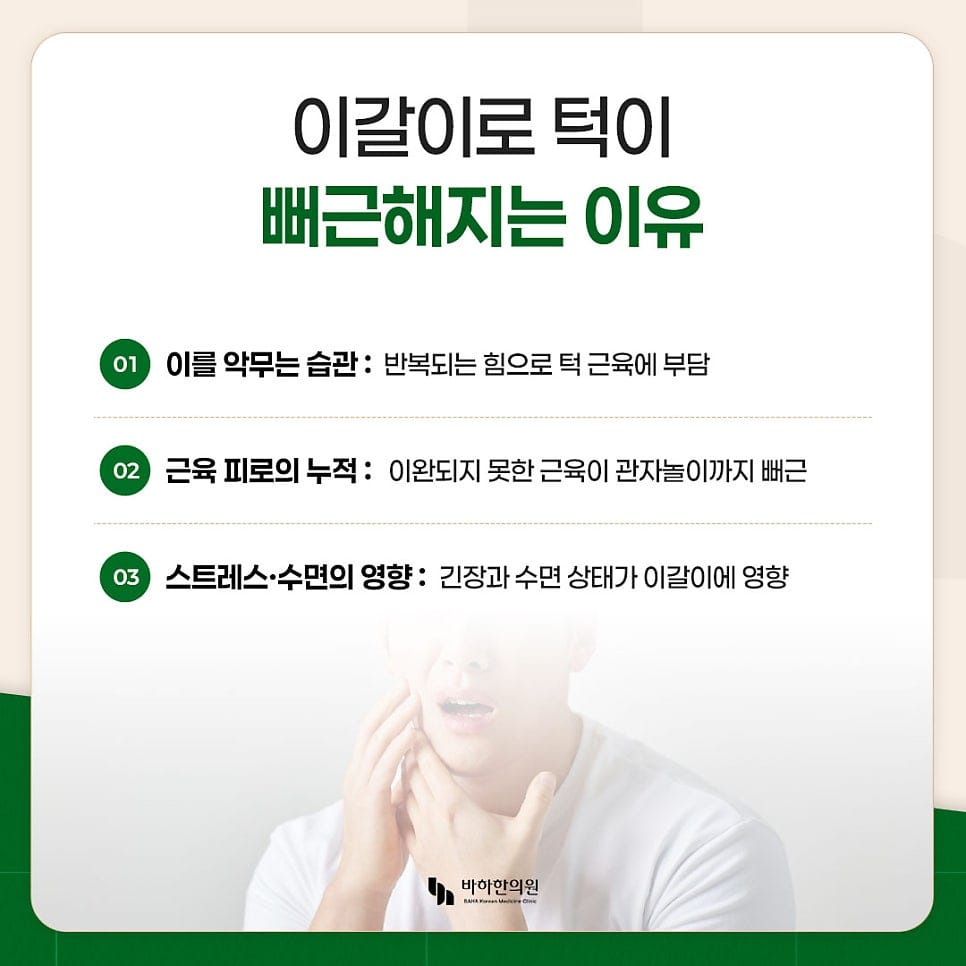
When the habit of forcefully clenching or grinding the teeth is repeated, it can place strain on the muscles that move the jaw.
Teeth grinding can be associated with various factors, including stress, tension, and the quality of sleep.
Some people clench their teeth not only during sleep but also unknowingly throughout the day — for example, keeping the upper and lower teeth tightly pressed together while concentrating on work or studying.
When this pattern continues, the muscles around the jaw may not relax sufficiently, leading to accumulated fatigue. The jaw may feel heavy, and aching can extend to the area around the temples. That said, having a teeth-grinding habit does not necessarily mean a TMJ disorder will develop.
Even among people with the same grinding habit, some experience no particular discomfort while others report pain or muscle tension around the jaw. Therefore, rather than automatically attributing jaw pain to teeth grinding, it is better to examine where and when the pain occurs and how the jaw moves.
What symptoms can appear with TMJ pain?
One of the first things people notice when there is discomfort in the TMJ is stiffness around the jaw.
Some experience a heavy feeling in the jaw upon waking, or pain in front of the ear when chewing.
The jaw may also feel tight when opening wide, or a clicking sound may occur during movement.
People with pronounced tension in the muscles around the jaw may experience pain extending to the temples or cheeks, and may also have headaches. In particular, if the following symptoms recur, it is worth having the condition of your TMJ assessed.
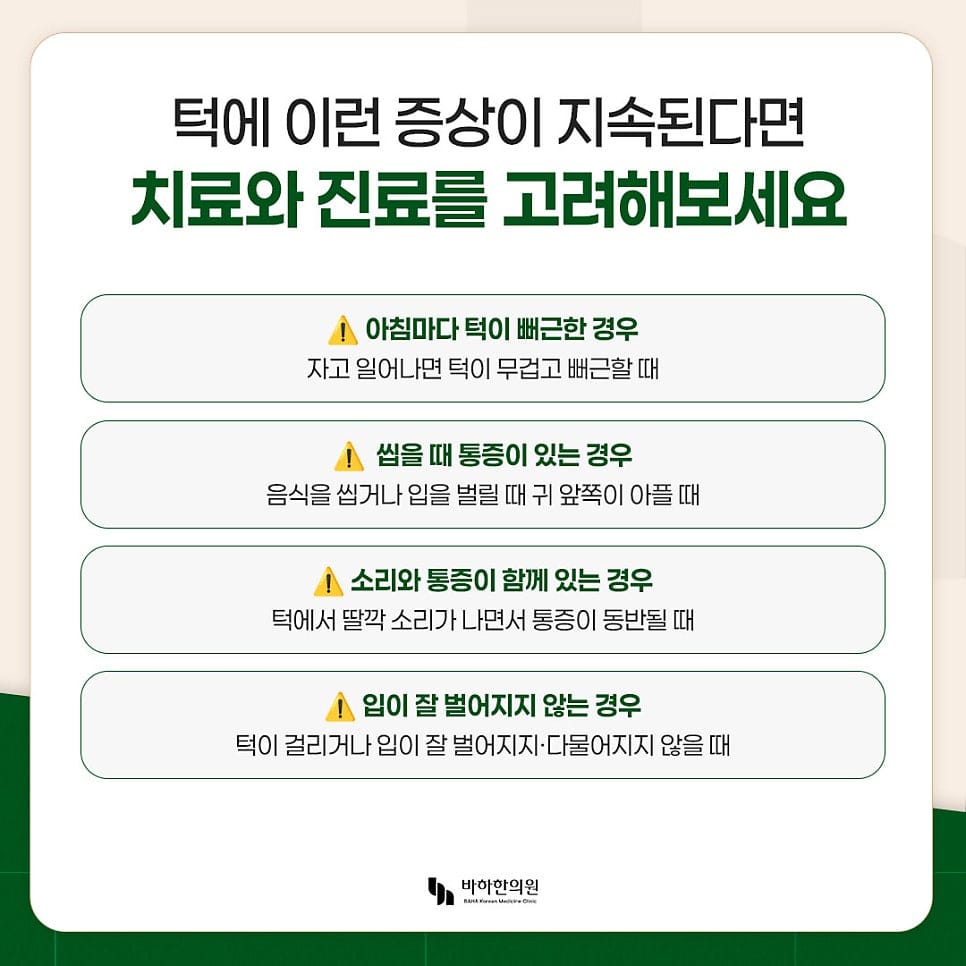
• A feeling of stiffness or heaviness around the jaw every morning
• Pain when chewing or opening the mouth
• A clicking or popping sound in the jaw accompanied by pain
• Difficulty opening the mouth as wide as usual, or a sensation of the jaw catching
Not every jaw sound requires treatment. Sometimes sounds occur without any pain, so it is important to also consider the actual degree of discomfort and the range of mouth opening. On the other hand, if pain persists or jaw movement becomes restricted to the point of interfering with meals, it is advisable to identify the cause.
If the mouth suddenly cannot be opened or closed, or if pain develops following an injury, prompt medical attention may be needed. When TMJ pain is present, it is important to first look at daily habits. One key aspect of managing TMJ pain is recognizing how much tension you habitually place on your jaw.
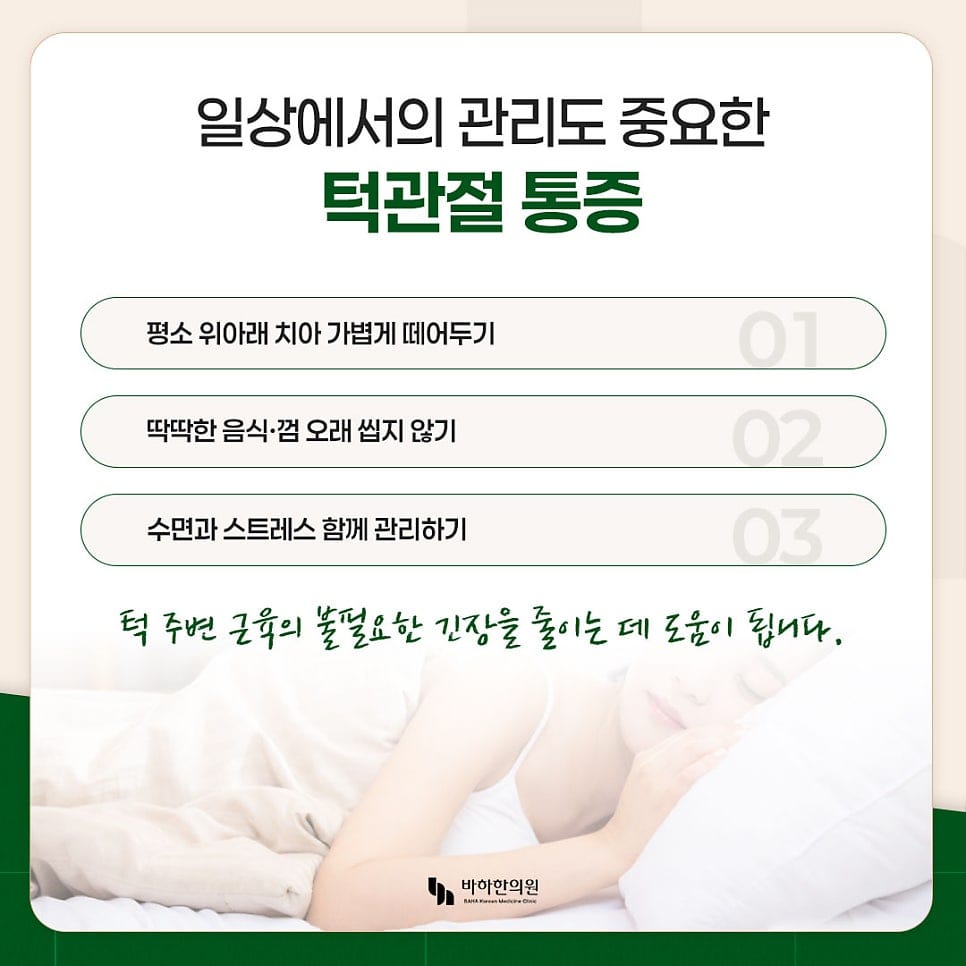
Some people unconsciously clench their teeth or hold tension in their jaw throughout the day.
Except when chewing or speaking, lightly separating the upper and lower teeth and releasing the tension in the muscles around the jaw can be helpful. During periods of jaw discomfort, it is also advisable to avoid chewing tough or hard foods for extended periods, as well as habits such as long-term gum chewing or opening the mouth excessively wide.
Sleep and stress management are equally important.
Because teeth grinding can be influenced by multiple overlapping factors, it is worth reflecting on your general level of tension and sleep habits rather than focusing only on the jaw area. Applying a warm compress in a gentle, non-forceful manner can be helpful when the jaw feels stiff. Forceful massage or deliberately pushing the jaw when pain is severe may worsen discomfort and should be avoided.
How does Korean medicine approach TMJ pain?
Even when the symptom is the same — 'jaw pain' — the way discomfort presents can differ from person to person.
Some people feel stiffness in the muscles around the jaw upon waking, while others experience increased pain when chewing.
Others notice sounds when moving the jaw, or report tension extending into the neck and shoulders as well.
In Korean medicine, when examining discomfort around the TMJ, we consider not only the area where pain appears but also the individual's overall physical condition, including habitual tension levels, sleep quality, and lifestyle.
For example, if the habit of clenching teeth has worsened during a particularly stressful period, or if jaw tension is accompanied by stiffness in the neck and shoulders, we also take into account the circumstances in which these symptoms arise.
However, since neck and shoulder tension is not the cause of all TMJ pain, it is important to evaluate each symptom and its relationship to the others individually.
At Baha Korean Medicine Clinic, we begin with a detailed consultation to understand the patient's teeth-grinding and clenching habits, when the pain started, and their daily routine.
We then assess the range and quality of jaw opening and closing, as well as muscle tension and tenderness around the jaw, in order to determine an appropriate treatment approach for each individual.
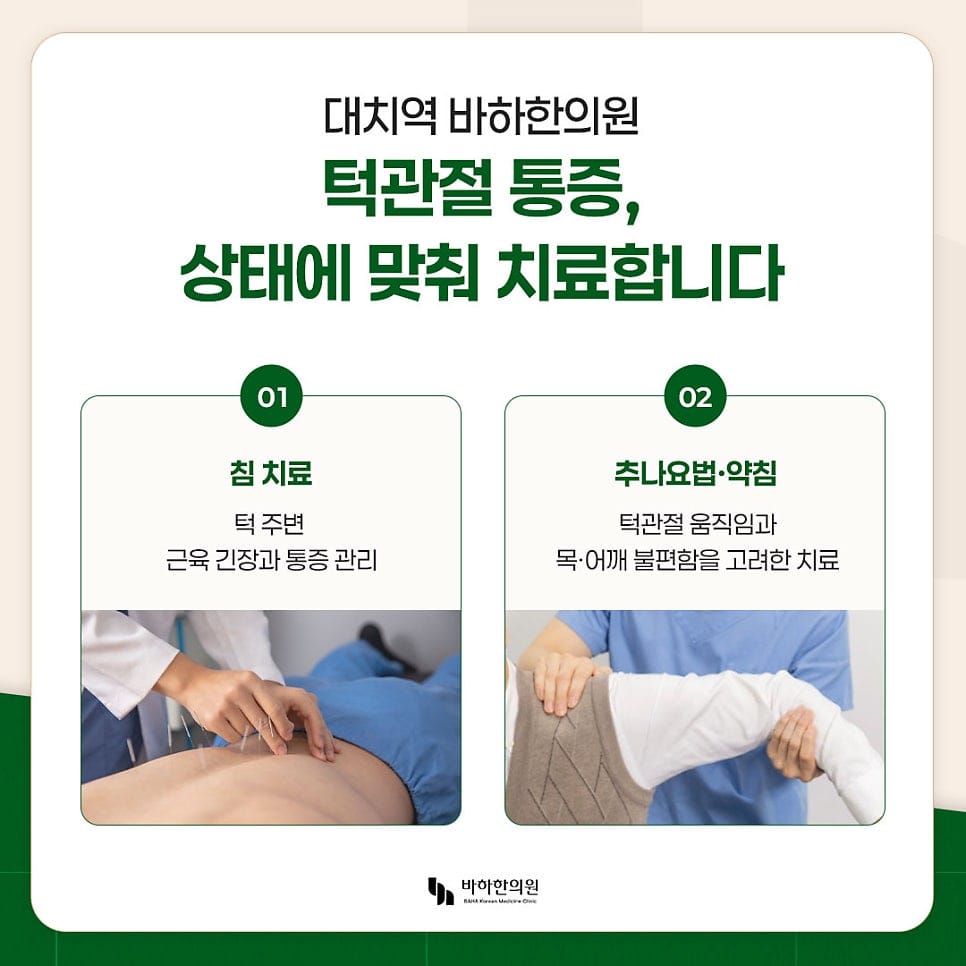
When muscle tension and pain around the jaw are prominent, acupuncture may be considered. If there is accompanying restriction in jaw movement or discomfort in the neck and shoulder area, the applicability of chuna (spinal manipulation) and other manual therapy techniques, as well as pharmacopuncture, may be reviewed based on the individual's condition.
These treatments are not applied uniformly to all patients; decisions are made after evaluating the pattern of pain, joint movement, and the individual's overall health. TMJ pain can be related not only to muscular issues but also to dental factors, bite alignment, or internal joint problems. When such issues are suspected, evaluation by a dentist or other relevant specialist may be necessary.
The key is not to choose a single treatment method simply because the jaw hurts, but to consider both the underlying cause of the discomfort and the patient's everyday habits together.
If TMJ pain keeps recurring, look for the cause rather than simply enduring it
The TMJ is used frequently in daily life — for chewing and talking — so even minor discomfort can become a burden when it repeats.
If you are looking for a Korean medicine clinic in Daechi-dong, or if jaw stiffness from teeth grinding continues, please reflect on your clenching habits and daily environment, and if necessary, please visit us for an assessment of your current TMJ condition.
Because the causes and symptoms of TMJ pain vary from person to person, it is important to continue treatment and lifestyle management suited to your individual situation.