Neck and Shoulder Pain at Daechi Station: Why Treating Only the Painful Area Keeps Failing
Discover why neck and shoulder pain keeps recurring and how Baha Korean Medicine Clinic near Daechi Station, Gangnam corrects the root cause through thoracic and scapular rehabilitation.
Hello, I'm Dr. Shin Jong-hoon.
For office workers staring at monitors all day, students sitting at a desk for hours on end, and heavy smartphone users alike, neck and shoulder pain has become an almost unavoidable chronic complaint in modern life. You rub and loosen the sore neck or trapezius muscles, yet the pain keeps coming back rather than disappearing for good — why is that?
The reason is straightforward. Temporarily relieving only the painful spot, without understanding the interconnected chain formed by the spine, scapulae, and thoracic vertebrae, cannot address the root cause. Today, we'll take a detailed look at the biomechanical principles behind chronic neck and shoulder pain — including posture and movement patterns — and explain the fundamental treatments that correct them.
When the cervical spine maintains its normal C-shaped curve, the weight of the head is distributed evenly across each vertebral segment and the surrounding muscles. However, every 15 degrees the head tilts forward, the load that the cervical spine must bear increases sharply. The problem with forward head posture (text neck) is that the splenius, trapezius, and levator scapulae muscles at the back of the neck must remain in a constant state of tension all day just to keep the head from falling forward. In other words, a stiff, tight trapezius and an aching neck are not signs that the muscles themselves are damaged — they are your body's signal that these muscles are overworking simply to prop up a head that has shifted out of its proper position.
When you look at the posture of people who experience neck and shoulder pain, the neck is rarely the only thing that has shifted forward. A cascading series of changes involving the entire spine and the shoulder joints typically accompanies it.
The first is forward head posture / straight neck and loss of cervical curvature. A straight neck (loss of cervical lordosis) that has lost its normal C-shaped flexibility absorbs shock far less effectively. This places continuous pressure on the intervertebral discs and facet joints, leading not only to chronic neck pain but also to restricted blood flow to the head — which can trigger tension headaches and eye fatigue.
The second is rounded shoulders and upper crossed syndrome. When a person works for extended periods with the head tilted down and arms reaching forward, the pectoralis minor and pectoralis major at the front of the chest shorten and tighten. As the chest muscles contract, the shoulders roll forward, while the muscles of the upper back become lengthened and weakened. This imbalance — shortened in front, weakened in back — is called upper crossed syndrome.
The third is thoracic kyphosis and reduced thoracic mobility. Because the thoracic spine sits directly below the cervical spine, when it rounds excessively the cervical spine is biomechanically forced to shift forward. As thoracic kyphosis deepens and the thoracic vertebrae stiffen, the cervical spine and scapulae lose their proper position — and this is the deepest root cause of chronic neck and shoulder pain.
The most important factor in neck and shoulder pain is the mobility of the scapulae and thoracic spine. The shoulder joint has the greatest range of motion of any joint in the human body. When you raise your arm or rotate it behind you, it is not the shoulder joint alone that moves — the scapula must smoothly upwardly rotate and glide along the back of the ribcage. The thoracic spine must also extend and rotate freely to allow the neck and shoulder to move without strain.
But what happens when poor posture causes the thoracic spine to stiffen and the scapulae to become locked against the ribcage?
When you raise your arm or turn your head, the thoracic spine and scapulae — which should be doing the work — fail to do their job. As a result, the smaller muscles around the cervical spine and shoulder are forced to compensate, twisting and bending far beyond their intended range. In other words, the neck and trapezius are forced to overwork in place of the stiffened thoracic spine and scapulae, and this compensatory pattern repeating thousands of times every day sustains the inflammation and pain in the affected areas. This is precisely why pain keeps returning no matter how often you loosen the sore trapezius: until mobility in the thoracic spine and scapulae is restored, the pain will continue to recur.
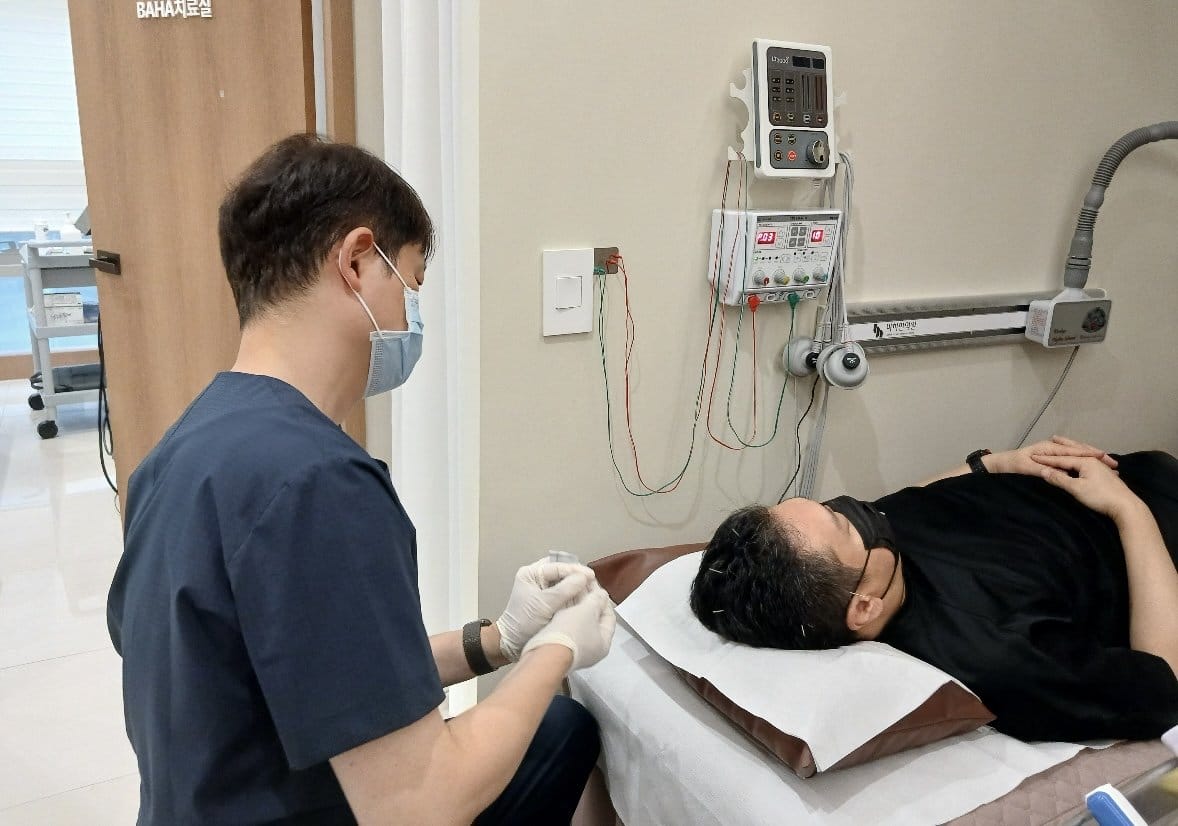
It is important to build daily habits that protect neck and shoulder health and to maintain correct movement patterns.
First, align your monitor and smartphone to eye level. Use a monitor stand to ensure your line of sight does not drop more than 15 degrees below horizontal, and hold your smartphone up to eye level when using it to prevent your head from tilting forward.
Second, do a chest-opening stretch after every 50 minutes of work. Every hour, stand up, extend both arms behind you to stretch the pectoralis minor at the front of the chest, and draw the scapulae toward each other at the back. Hold for 10 seconds and repeat several times.
Third, practice chin tucks. While looking straight ahead, gently push your chin back with your index finger to lengthen the muscles at the back of the neck. Doing this frequently is very helpful for restoring the natural C-curve of the cervical spine.
At Baha Korean Medicine Clinic near Daechi Station, we go beyond simple pain relief — we aim to fundamentally correct the postural imbalances and the movement dysfunction in the thoracic spine and scapulae that have been causing your neck and shoulder pain. If you are suffering from recurring neck and shoulder pain, please do not endure it alone. Please visit Baha Korean Medicine Clinic for a thorough diagnosis and a systematic, individualized Korean medicine treatment plan.